2026-09-10 ·
Leveling Concrete Around Pool Decks in Pacific Beach
# Leveling Concrete Around Pool Decks in Pacific Beach
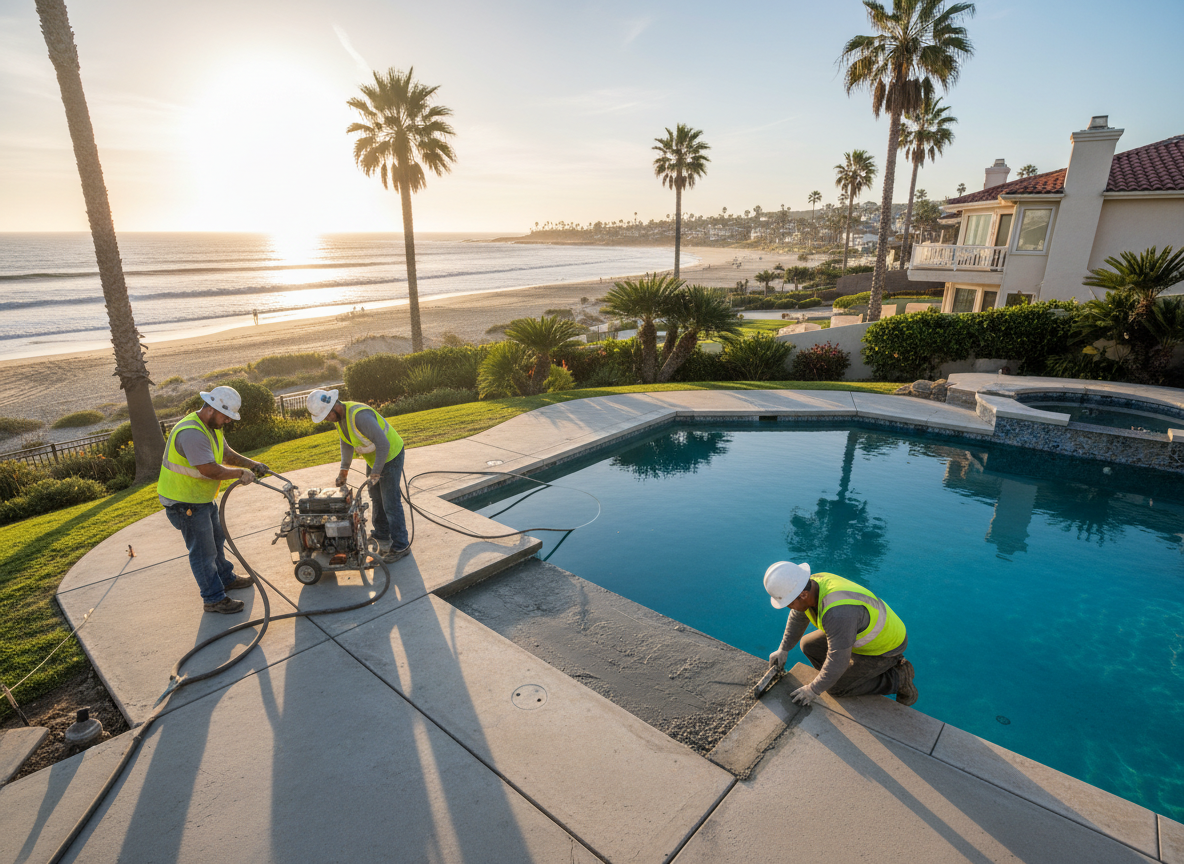
Concrete leveling can correct many sunken pool deck slabs in Pacific Beach without removing the entire deck. The process raises intact concrete in controlled increments, closes uneven transitions, and can restore the deck’s intended drainage. It is most appropriate when a slab has settled but is still structurally sound; widespread cracking, severe surface deterioration, or damaged pool coping may require replacement or separate pool repairs instead. Around a pool, the work must be precise because lifting one panel affects adjacent joints, drains, skimmer openings, coping, and gates.
Why Pacific Beach Pool Decks Settle
Pacific Beach’s mild coastal Mediterranean climate allows pools and outdoor living spaces to be used through much of the year, but mild weather does not eliminate settlement. Water escaping through open joints, leaking irrigation, or frequent deck washing can move into the material beneath a slab. If that base was loosely compacted or has developed voids, the panel can lose support and drop. A low panel may then collect more water, accelerating the same cycle.
Lot conditions vary across Pacific Beach. Properties closer to the coast may have different fill and drainage behavior than sites rising toward the inland slopes, so the cause should be evaluated at the individual deck rather than assumed from the ZIP code. Older San Diego housing also commonly has outdoor concrete that has been patched, extended, or poured in separate phases. Those sections may settle independently because they have different base preparation and joint layouts.
The same principles apply elsewhere in San Diego County, including La Jolla, Mission Valley, Chula Vista, Coronado, and La Mesa, but coastal exposure and compact lots make access and water control especially important in Pacific Beach.
Signs That Leveling May Be Appropriate
A pool deck does not need to look dramatically sunken to create a problem. Even a modest vertical edge can catch bare feet, interfere with movable pool equipment, or keep a gate from clearing the surface. The key is distinguishing settlement from concrete that is failing internally.
Look for these practical indicators:
- A raised joint edge where 1 slab has dropped below the next
- Puddles that remain after normal evaporation instead of reaching a drain
- Gaps beneath slab edges that suggest the base is no longer supporting the concrete
- A widening joint near coping, a drain channel, or a wall
- Doors or pool gates rubbing after the surrounding pavement changes elevation
Leveling is generally worth evaluating when the slab remains in recognizable sections and has limited cracking. Panels broken into several loose pieces are poor lifting candidates because pressure can separate them further. Before planning pool deck leveling, also check whether the pool shell, coping, or plumbing is moving. Concrete leveling supports the deck; it does not repair a leaking pool line or structural pool damage.
How Pool Deck Leveling Is Planned
A careful pool deck lift starts with elevations, not injection holes. The technician identifies the low point, checks the direction of surface flow, and determines which edges are restrained by coping, walls, drains, or neighboring slabs. The goal is not always to make every panel perfectly level. Pool decks usually need a controlled slope that moves water away from the pool and buildings without directing runoff onto a neighboring property.
A typical plan follows this sequence:
- Map the settled panels and identify stable reference points.
- Check drainage paths, including deck drains and discharge points.
- Inspect joints and cracks for evidence of washout or repeated movement.
- Select injection locations that provide balanced support beneath the slab.
- Lift in small stages, moving between ports rather than forcing 1 corner upward.
- Recheck gates, coping, drains, and transitions before patching the access holes.
Compact Pacific Beach properties can limit equipment access, so hose routes, side-yard clearance, landscaping, and pool equipment pads should be reviewed beforehand. If several deck sections have dropped, broader sunken concrete repair may be more useful than treating a single visible edge.
Mudjacking Around Pools
Mudjacking raises concrete by pumping a cementitious slurry beneath the slab. The material fills accessible voids and applies upward pressure, allowing the panel to be brought closer to its intended elevation. It can be effective where the concrete is thick enough to drill and where the base conditions allow the slurry to spread predictably.
Pool decks demand more restraint than an open driveway. Too much pressure near coping can push against the pool edge, while lifting a panel without watching the drain can create a new low spot. Injection holes also need thoughtful placement so they do not interfere with decorative scoring, textured finishes, anchors, or embedded utilities. No lifting method should be treated as a way to conceal an active plumbing leak.
Mudjacking material adds weight beneath the slab, which is one reason base conditions matter. The contractor should compare it with other available lifting approaches based on slab condition, access, void size, and the amount of correction required. For a broader example of how moisture changes and ground movement affect slabs elsewhere in the city, see drought cycles and concrete in North Park.
Protecting Drainage And The Finished Deck
After lifting, water management determines whether the repair has addressed the cause or only the symptom. Open control joints and separations can admit pool splash, rain, and wash water beneath the concrete. Pacific Beach does not receive constant heavy rainfall, but occasional wet periods can expose a poorly draining deck quickly. Irrigation overspray can be more persistent because it repeatedly wets the same edge throughout otherwise dry weather.
Keep these areas under observation after the work:
- Deck-to-coping joints and transitions around drain bodies
- Downspouts or roof runoff discharging beside the pool deck
- Planters that hold moisture against slab edges
- Irrigation heads spraying joints or the base of retaining walls
- Repaired cracks that reopen or collect sediment
Joint treatment and concrete sealing can help limit surface absorption and water entry where appropriate, but neither substitutes for proper drainage or leak repair. Avoid coating over moving joints without understanding where movement must be accommodated. A sound finish should preserve traction around wet surfaces rather than leave the deck slick.
Deciding Between Leveling And Replacement
Choose leveling when the main problem is loss of support beneath otherwise serviceable panels. Replacement becomes more practical when the slab is extensively shattered, severely spalled, incorrectly pitched across a large area, or constrained so tightly that lifting would threaten coping or nearby construction. Decorative concrete also deserves special attention: lifting preserves the existing panel, but patched injection holes may remain visible in colored, exposed-aggregate, or heavily textured finishes.
Before approving work, ask for an explanation of the proposed lift points, target elevations, drainage path, and any areas that cannot be corrected safely. An upfront quote should separate leveling from optional joint work or sealing so the scope is easy to inspect. San Diego Concrete Leveling serves San Diego and is available Mon–Fri, 8am–6pm, and Sat, 9am–2pm.
The practical objective in Pacific Beach is a supported deck with safer transitions and drainage that still works around the pool. Careful diagnosis matters more than forcing every slab to the same height, especially where older concrete, tight side yards, pool equipment, and coastal property layouts leave little room for error.