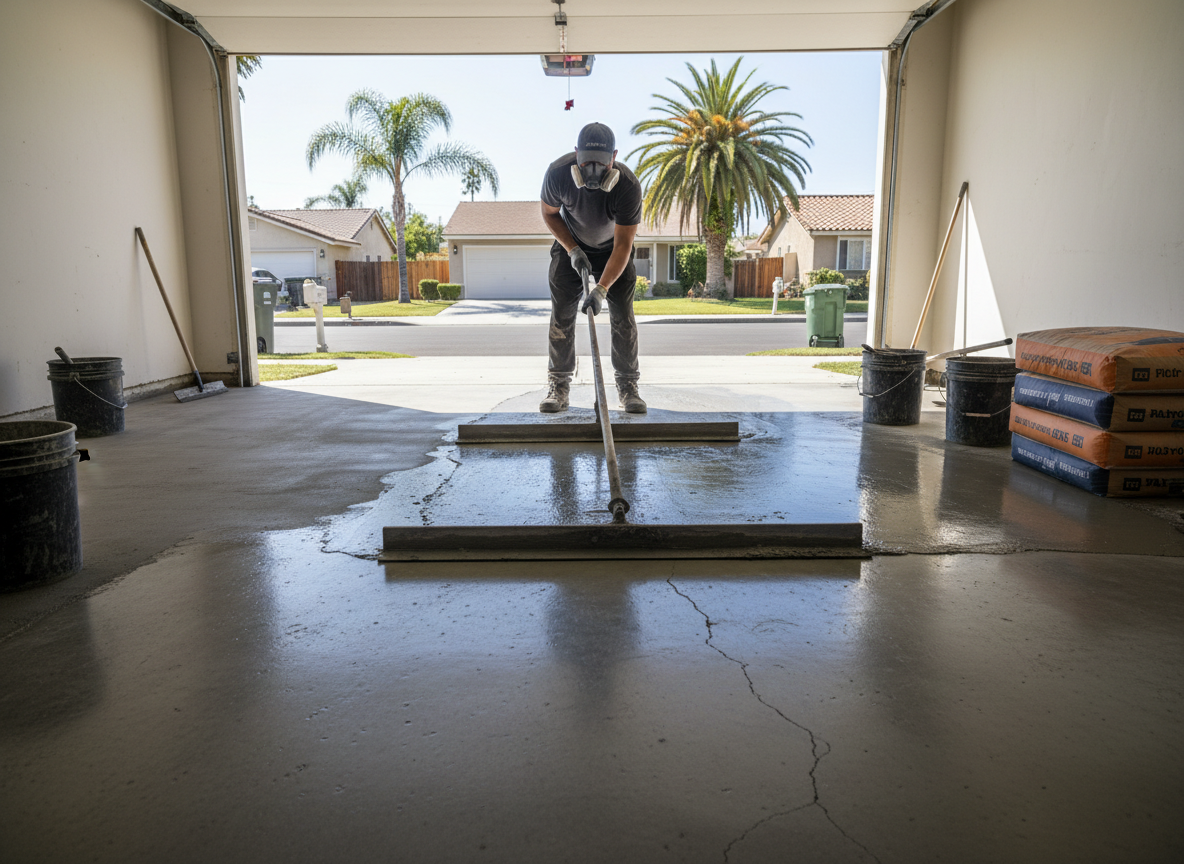
Garage floor leveling corrects settled slab sections that create rocking vehicles, abrupt lips, widening cracks or doors that no longer meet the floor evenly. In San Diego, the repair must begin with the cause rather than the visible low spot. Water entering beside a driveway, leaking irrigation, poorly compacted fill and hillside runoff can wash or consolidate material beneath a garage slab. These conditions vary considerably between flatter properties in North Park and Mission Valley and sloped lots around La Jolla. We inspect the crack pattern, panel movement, perimeter support and drainage before deciding whether lifting is appropriate or the concrete has deteriorated beyond a practical leveling repair.
Most liftable garage floors are adjusted by drilling small access holes and introducing a controlled lifting material beneath the slab. Traditional mudjacking uses a cementitious slurry and generally requires larger holes; polyurethane systems use expanding material that can fill voids through smaller injection points. Material choice depends on slab condition, access, void depth and the amount of lift needed. A slab should be raised incrementally because aggressive lifting can open cracks, bind the garage door or disturb adjacent walls. If the floor is badly broken, heaved upward or unsupported at multiple edges, partial or full replacement may be more reliable than forcing damaged sections back into plane.
A garage floor should not simply be made perfectly level without considering drainage. The floor needs to direct incidental liquids toward an appropriate outlet, commonly the vehicle doorway, rather than toward the home. During planning, we check transitions at the driveway, stem walls, door thresholds, floor drains and the step into living space. Work near attached-garage walls must also avoid damaging components involved in the garage-to-house separation. Significant reconstruction, drain changes or structural work may require review under current San Diego permitting and building requirements; slab lifting alone is different from rebuilding a foundation or altering a drainage system.
San Diego County’s mild coastal climate allows leveling through much of the year, but dry weather does not eliminate moisture-related settlement. Irrigation leaks can continue unnoticed, and runoff may concentrate beside garages during seasonal rain. Coastal exposure near Pacific Beach, Coronado and La Jolla Cove can also leave older slabs with surface scaling or corroded embedded metal, which lifting will not repair. Inland properties toward La Mesa may present different soil movement and fill conditions, while garages in Chula Vista developments can have settlement concentrated at driveway interfaces. The correct repair separates stable, liftable concrete from concrete that needs drainage correction, crack treatment or replacement.
Technician insight
In San Diego, the thing that catches most people out with garage floor leveling is irrigation or runoff continuing to feed the same edge that settled. On sloped La Jolla lots and older North Park properties, correcting the elevation without addressing that water path can leave the underlying cause in place. I also watch the garage-door seal closely because a lift that improves the floor can expose a door or driveway alignment problem that was previously hidden.
Garage Floor Leveling Services We Offer
✓Sunken Garage Slab Leveling
Raises settled garage floor sections to reduce low spots, abrupt panel edges and uneven tire paths while preserving the slab when its concrete remains sound.
✓Garage Floor Mudjacking
Uses a cement-based slurry to fill accessible voids and lift suitable slabs. We assess slab thickness, required lift and access because mudjacking is not appropriate for every cracked or lightly built floor.
✓Polyurethane Garage Slab Lifting
Injects expanding material through relatively small access holes for controlled lifting and void filling. This approach can be useful where added slurry weight or limited drilling access is a concern.
✓Garage-To-Driveway Transition Leveling
Corrects settled concrete at the garage entrance to reduce tire impact, scraping and water collection. The finished elevation must still maintain practical drainage away from the garage interior.
✓Garage Slab Void Filling
Fills unsupported spaces beneath concrete before movement becomes more severe. Void filling may stabilize a panel even when little or no elevation change is required.
✓Cracked Garage Panel Stabilization
Addresses movement beneath cracked but potentially serviceable panels, followed by appropriate crack treatment where feasible. Loose fragments, widespread crushing or vertical heave may instead call for replacement.
✓Garage Floor Drainage Correction Planning
Evaluates low areas, doorway elevations and water paths before lifting begins. Leveling can redirect water, so drainage consequences must be planned rather than discovered after the slab moves.
Garage Floor Leveling Cost in San Diego, CA
| Service | Typical Range | What Affects It |
|---|---|---|
| Small Localized Garage Slab Lift | $900–$2,000 | Typically applies to one accessible settled area; minimum mobilization, void depth and material volume can move the price. |
| Multiple Garage Floor Sections | $1,800–$4,500 | Varies with garage size, number of injection zones, total lift and whether cracks divide the floor into independently moving panels. |
| Garage-To-Driveway Transition Correction | $800–$2,500 | Depends on whether the garage slab, driveway panel or both have moved and whether drainage must be preserved or corrected. |
| Garage Slab Void Filling Without Major Lift | $900–$3,000 | Material volume and access drive cost; a broad subsurface void can require more material than the surface symptoms suggest. |
| Extensive Leveling Or Complex Access | $3,500–$7,500+ | May apply to broad settlement, deep voids, restricted access or multiple affected panels; severely damaged concrete may be better priced for replacement. |
Ranges are typical for San Diego, CA and confirmed with an exact written quote before any work starts.
How it works
- 1
Inspect The Slab And Site Conditions
We document low areas, cracks, panel edges, wall clearances, garage-door contact and the transition to the driveway. We also look for irrigation, downspout or runoff patterns that may have contributed to settlement.
- 2
Map Elevations And Choose The Repair
Elevation readings show how the floor currently drains and how much movement is realistic. We then determine whether polyurethane lifting, mudjacking, stabilization or replacement is the sounder option.
- 3
Lift And Fill In Controlled Stages
Small access holes are placed strategically, and material is introduced in measured increments. The slab is monitored continuously to limit over-lifting and unwanted pressure against adjacent construction.
- 4
Verify Drainage And Finish Access Points
We recheck elevations, doorway operation and water direction, then patch the injection holes. Any remaining cracks, surface damage or drainage issues are identified separately rather than concealed.
Pricing
Garage floor leveling is priced after an on-site evaluation because the visible low spot does not reveal the volume of the void beneath it. San Diego pricing is usually affected by the number and size of panels, required lift, injection material, drilling access, crack severity, drainage complications and whether the garage must be cleared. Broad planning ranges are useful, but replacement, structural repair, coatings and plumbing or drain work should be quoted separately.