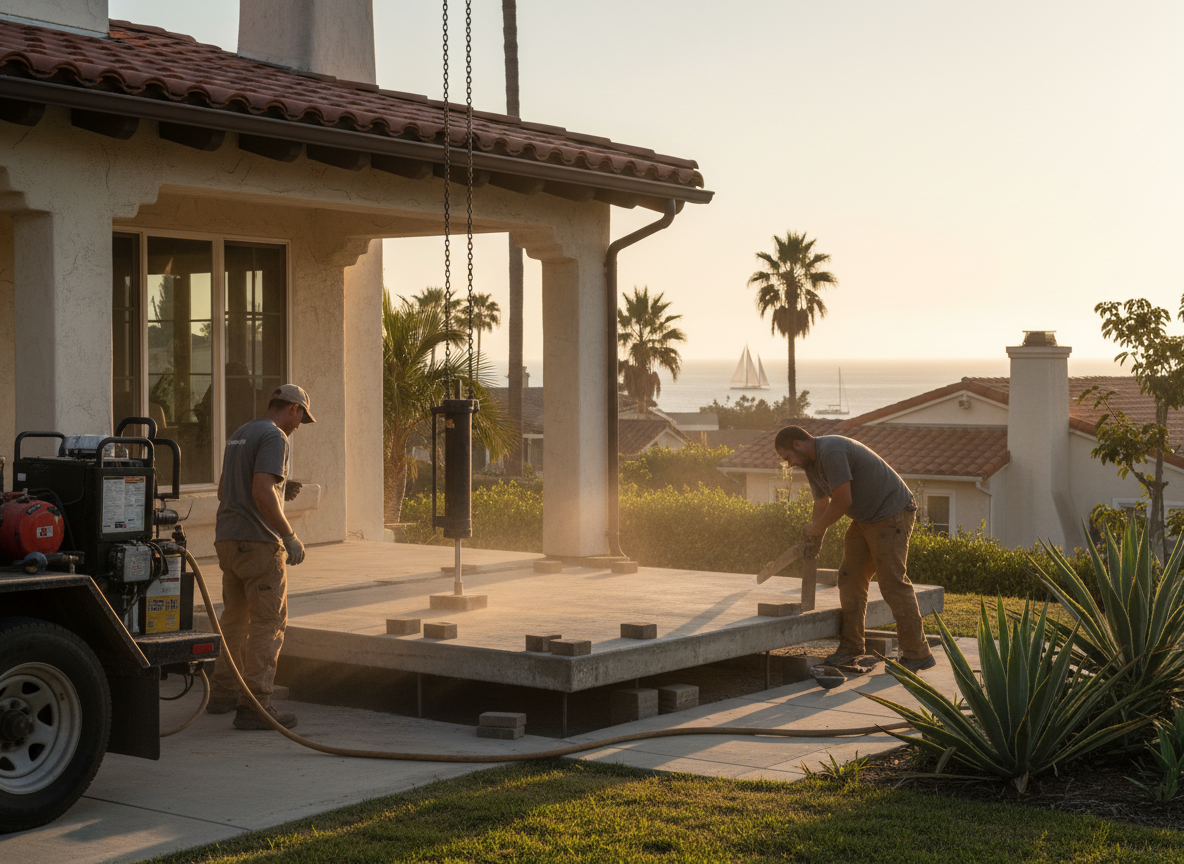
Patio and porch leveling raises settled concrete without automatically replacing the entire slab. After checking the direction and amount of movement, access points are drilled and a leveling material is introduced beneath the concrete to fill voids and lift low sections. Mudjacking uses a cementitious slurry, while other concrete leveling methods may use a lighter expanding material. Method selection depends on slab thickness, access, soil support, nearby walls and the amount of lift required. The goal is controlled correction, not simply making one edge look higher. Cracked pieces, badly deteriorated surfaces or slabs that cannot tolerate lifting may be better candidates for partial or complete replacement.
San Diego’s mild coastal Mediterranean climate means patios remain in use throughout much of the year, but settlement is still common where irrigation, downspouts or plumbing leaks repeatedly wet the material beneath a slab. Properties on sloped lots in La Jolla and Mission Valley require particular attention to runoff and downhill edges, while dense sites in North Park may have narrow access between older homes, retaining walls and porch foundations. Near Pacific Beach and La Jolla Cove, surface wear and exposed steel also need inspection before lifting. Leveling can correct the slab position, but it will not stop movement caused by an unresolved leak, failed drain or eroding edge support.
Drainage and building clearances guide every porch or patio lift. Concrete should generally direct water away from the structure rather than toward doors, stucco weep areas, vents or foundation joints. A slab also cannot be raised blindly beneath steps, columns, railings or attached patio covers; those features may carry loads independently or restrict movement. Around Downtown San Diego, Coronado and older parts of North Park, porch slabs may meet historic masonry, narrow landings or previous overlays that complicate drilling and lifting. Work affecting structural supports, accessible routes or regulated egress may require separate review by the appropriate authority in San Diego County. Leveling is not a substitute for structural engineering when a porch foundation, wall or supporting column has moved.
Technician insight
In San Diego, the thing that catches most people out with patio and porch leveling is focusing on the visible low corner without finding where the water is coming from. Irrigation overspray, a leaking line or runoff on a sloped La Jolla or Mission Valley lot can remove support again after a successful lift. I also watch door thresholds closely because improving one patio edge can send water toward the house if the entire drainage plane is not measured first.
Patio and Porch Leveling Services We Offer
✓Sunken Patio Slab Leveling
Raise low patio panels to reduce abrupt edges and restore a more consistent walking surface. The evaluation includes drainage direction, joint condition and whether the slab remains sound enough to lift.
✓Front Porch Slab Leveling
Correct settlement at porch landings while protecting thresholds, steps, columns and adjacent foundations. Lift limits are established before work begins so the slab does not bind against fixed building components.
✓Mudjacking for Patios and Porches
Use a cement-based slurry to fill accessible voids and lift suitable concrete slabs. Mudjacking is considered where slab condition, access and underlying support make the added material appropriate.
✓Trip Hazard Correction
Reduce raised transitions between adjoining patio or porch panels when leveling is a better fit than surface grinding. This addresses the elevation difference while preserving usable concrete.
✓Patio Drainage Slope Correction
Adjust settled sections that direct irrigation or rainwater toward the home. Leveling is planned around door clearances, drains and joints rather than forcing the patio perfectly level.
✓Void Filling Beneath Concrete
Fill unsupported spaces beneath patio or porch slabs before they lead to additional rocking or settlement. The source of washout or water intrusion should also be corrected for a more durable result.
✓Porch Step and Landing Alignment
Improve uneven transitions where a porch landing meets steps or a walkway. Fixed steps, code-sensitive riser relationships and handrail connections are checked before any lift.
Patio and Porch Leveling Cost in San Diego, CA
| Service | Typical Range | What Affects It |
|---|---|---|
| Small Single-Panel Patio Lift | $600–$1,500 | Assumes sound concrete, straightforward access and a limited lift; minimum service charges often influence small jobs. |
| Multi-Panel Patio Leveling | $1,500–$4,500 | Varies with total slab area, number of joints, void volume, elevation changes and access for equipment. |
| Front Porch Or Landing Leveling | $900–$3,000 | Door thresholds, attached steps, columns, railings and restricted drilling locations can increase complexity. |
| Void Filling Without Major Lift | $700–$2,500 | Pricing depends on the estimated void size, material required and whether the unsupported area is reachable. |
| Complex Patio Drainage Correction | $2,000–$5,000+ | Applies when several panels must be adjusted around drains, walls or multiple fixed elevations; drain repairs and replacement concrete are separate. |
Ranges are typical for San Diego, CA and confirmed with an exact written quote before any work starts.
How it works
- 1
Inspect The Slab And Surroundings
We review cracks, joints, rocking sections, surface deterioration and contact with walls, steps, columns or patio covers. We also look for irrigation, drainage and plumbing conditions that may have contributed to settlement.
- 2
Measure Elevations And Drainage
Key elevations are compared at doors, foundations, drains and neighboring panels. The lift plan aims to reduce hazards and improve runoff without creating a new low spot or blocking required clearances.
- 3
Select The Leveling Approach
The slab’s condition, access, void depth and required correction determine whether mudjacking or another leveling method is appropriate. Concrete that is too thin, fragmented or structurally compromised may be referred for replacement instead.
- 4
Lift And Stabilize The Concrete
Material is introduced through planned access holes in controlled stages. Elevations are monitored throughout the lift to limit stress on the slab and adjoining construction.
- 5
Patch And Review The Result
Access holes are patched, transitions are checked and remaining limitations are explained. Recommendations may include redirecting a downspout, repairing irrigation or sealing joints to reduce future water entry.
Pricing
Most San Diego patio and porch leveling is priced after an on-site inspection because slab size alone does not determine cost. Access, number of settled panels, lift height, void volume, drilling constraints and nearby steps or structural supports all affect the quote. Small isolated corrections may fall near the lower end of the planning ranges below, while multiple panels or difficult access can cost more. These are broad budgeting ranges, not fixed offers.