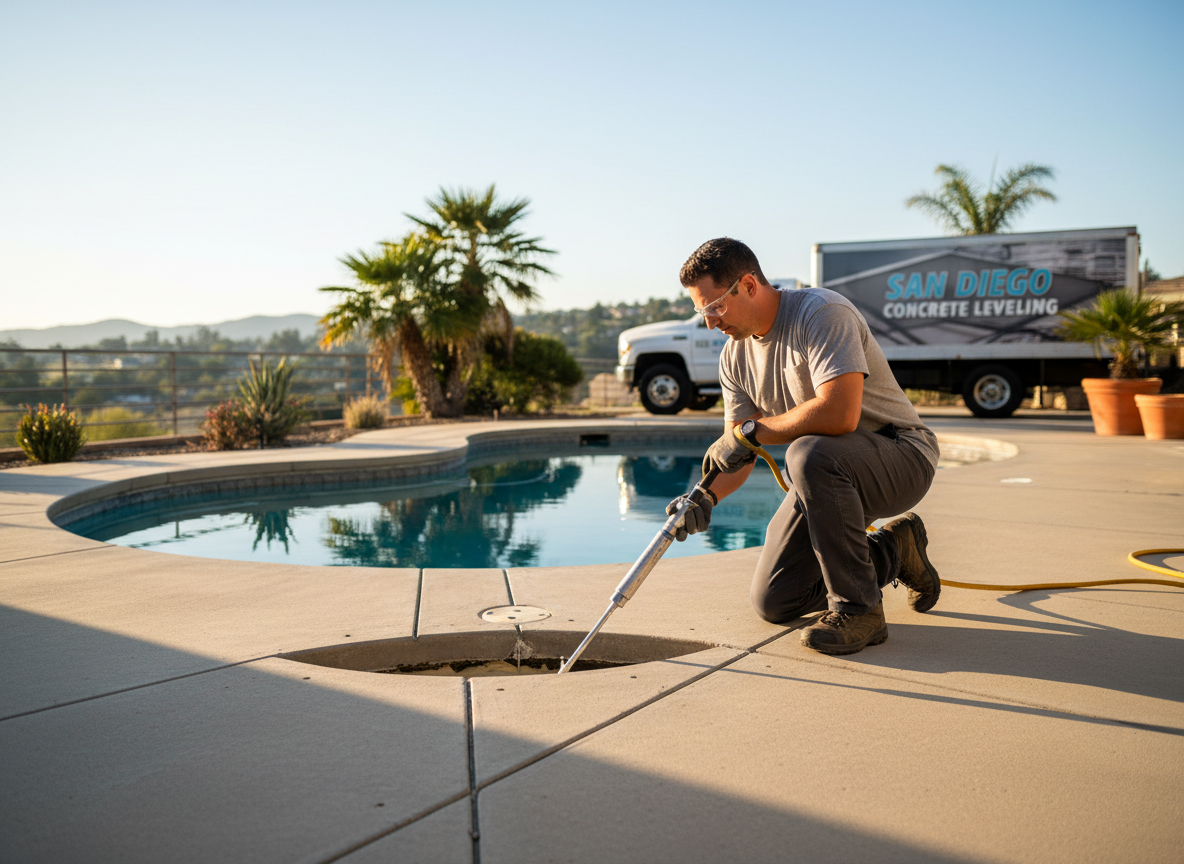
Pool deck leveling raises settled concrete sections without automatically replacing the entire deck. After identifying stable lift points, carefully placed material fills voids beneath the slab and brings adjoining edges closer to alignment. This approach can address trip lips, rocking panels and low spots that direct splash water toward a house or pool coping. It is not a cosmetic resurfacing treatment, and it will not erase existing cracks or restore deteriorated concrete. Around pools in La Jolla, Pacific Beach and Coronado, access, buried plumbing, deck drains and narrow clearances beside coping all influence where injection points can safely be placed.
San Diego County presents highly site-specific ground conditions. Coastal properties may have sandy soils, while hillside lots and developed canyon areas can include variable fill. In Mission Valley, drainage and past soil movement deserve particular attention; in older North Park properties, multiple concrete pours and previous patching can complicate the lift. The region’s mild Mediterranean climate limits freeze-thaw damage, but irrigation leaks, pool splash, failed joints and concentrated runoff can still wash fines from beneath a slab or soften supporting soil. Leveling should therefore be paired with correction of the water source whenever possible, or settlement may continue.
Pool decks require more restraint than ordinary sidewalk leveling. Raising a panel too aggressively can bind it against coping, change a drain’s slope, open an existing crack or place pressure near a skimmer throat and underground pool lines. Before work begins, the deck should be separated conceptually from the pool shell: concrete leveling can support and reposition eligible deck slabs, but it does not repair structural movement in the shell, bond beam or coping. Any work that changes barriers, drainage systems or structural pool components may require separate review under applicable City of San Diego or other municipal requirements in Chula Vista, La Mesa or Coronado.
Technician insight
In San Diego, the thing that catches most people out with pool deck leveling is assuming our mild weather prevents settlement. Around pools, long-term irrigation, splash water and leaking joints can move soil even without freeze-thaw cycles, especially where a property sits on variable fill or sloping ground. I pay close attention to coping and drain elevations because making one trip edge look better can create a drainage problem if the entire slab relationship is not considered.
Pool Deck Leveling Services We Offer
✓Sunken Pool Deck Slab Leveling
Raises eligible settled panels to reduce abrupt height differences and improve transitions between adjoining concrete sections.
✓Pool Deck Trip Hazard Correction
Targets raised edges and uneven joints along common walking routes, including paths between the house, pool steps and equipment area.
✓Pool Deck Drainage Slope Correction
Adjusts qualifying slabs where settlement causes water to collect or move toward the home. Existing drain elevations and coping clearances determine how much correction is practical.
✓Pool Coping Transition Leveling
Corrects deck panels that have dropped beside the coping while avoiding unnecessary pressure on the pool edge. Loose coping or bond-beam damage must be evaluated separately.
✓Pool Deck Void Filling
Fills accessible spaces beneath supported slabs to reduce rocking and improve contact with the underlying base. The source of erosion or soil loss should also be addressed.
✓Mudjacking Assessment
Evaluates whether conventional mudjacking is appropriate for the slab’s thickness, access and underlying conditions, or whether another leveling approach would place less load on weak soils.
✓Cracked Pool Deck Panel Leveling
Repositions structurally serviceable cracked panels when practical. Leveling can improve alignment, but the crack remains and may still require sealing or later replacement.
Pool Deck Leveling Cost in San Diego, CA
| Service | Typical Range | What Affects It |
|---|---|---|
| Small Isolated Pool Deck Section | $800–$1,800 | Typically involves one or two accessible panels with modest settlement and no major coping or drainage complications. |
| Multiple Pool Deck Panels | $1,800–$4,500 | Varies with total slab area, number of lift points, elevation differences and access for equipment. |
| Extensive Pool Deck Leveling | $4,000–$8,000+ | Applies to broad settlement or numerous panels; severe cracking, weak concrete or structural pool movement may make replacement more appropriate. |
| Void Filling Without Significant Lift | $700–$2,500 | Depends on the estimated void volume, slab access and whether erosion or active water movement is still present. |
| Joint Or Crack Sealing Add-On | $300–$1,200 | Depends on joint length, crack condition and compatible sealant requirements; sealing does not make a structural crack disappear. |
Ranges are typical for San Diego, CA and confirmed with an exact written quote before any work starts.
How it works
- 1
Inspect The Deck And Pool Edge
We review trip edges, cracks, coping clearances, drains, skimmers, equipment lines and signs of erosion or recurring water movement.
- 2
Measure Settlement And Drainage
Slab elevations and intended water flow are checked to determine which panels can be lifted and where fixed points limit movement.
- 3
Develop The Leveling Plan
The plan identifies lift points, target elevations, access constraints and areas where replacement or pool-structure repair would be more appropriate.
- 4
Lift And Stabilize Eligible Slabs
Material is introduced in controlled stages while panel movement, coping pressure and drainage relationships are monitored.
- 5
Verify Transitions And Clean The Site
Final elevations are checked, injection openings are patched and the work area is cleared. Any unresolved drainage or concrete deterioration is documented.
Pricing
Pool deck leveling is priced by the number and size of affected panels, required lift, access around the pool and proximity to coping, drains or buried plumbing. Small isolated areas may cost less than replacement, while extensively cracked, thin or poorly supported concrete may not be a good leveling candidate. The ranges below are planning figures for San Diego rather than quotes; an on-site assessment is needed before setting a price.