2026-09-10 ·
Checking Your Sidewalk for Trip Hazards Near Balboa Park
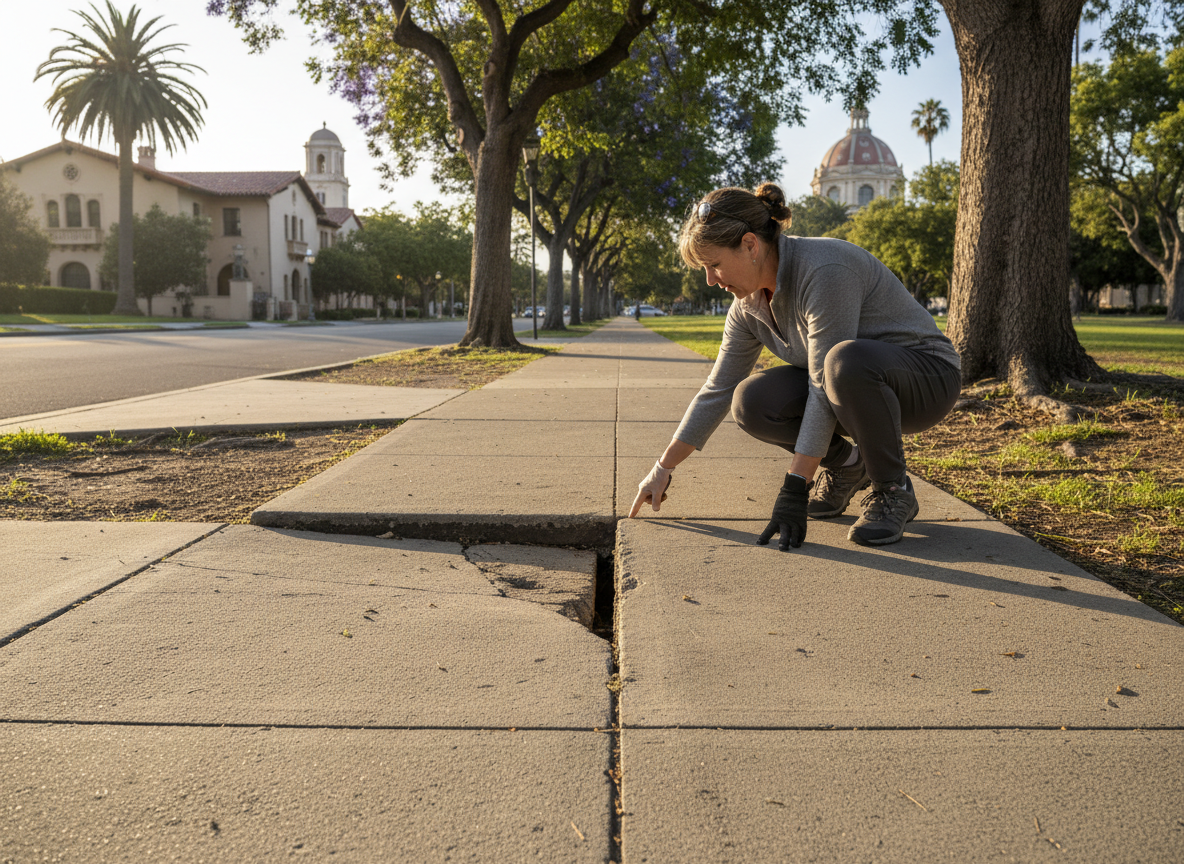
Check a sidewalk near Balboa Park by walking it in both directions, measuring every abrupt height change, and marking any edge that catches a shoe or mobility device. Treat a 1/4-inch vertical change as a reason for closer evaluation; larger offsets, rocking slabs, broken corners, and depressions that hold water deserve prompt attention. This is an inspection guideline rather than a determination of code compliance, which can depend on the sidewalk’s location, ownership, slope, and applicable public-agency requirements.
Start With A Slow, Methodical Walk
Inspect during full daylight after sweeping away leaves, mulch, and loose soil. Start at 1 end and walk each direction because an edge that feels harmless downhill may catch a toe when approached uphill. Around Balboa Park and nearby North Park, mature landscaping can hide lifted joints, while drive approaches and heavily used pedestrian routes create additional transition points.
Bring a 4-foot straightedge, a ruler, chalk, and a phone for photographs. Lay the straightedge across each joint and measure the vertical difference between slabs rather than estimating by eye. Record the address or location, the affected joint, the measured offset, and whether the slab moves under weight.
Flag these conditions:
- An abrupt lip of 1/4 inch or more
- A slab that rocks, sounds hollow, or shifts underfoot
- Cracks that have separated into uneven edges
- A depression where water, silt, or algae collects
- A corner broken beside a curb ramp, driveway, or utility cover
- A cross-slope that pushes walkers toward traffic or landscaping
Photograph each ruler measurement from the side so the height difference remains visible.
Look Beyond The Raised Edge
The visible trip edge is often only the symptom. Follow the slab’s slope and look for where water comes from and where it goes. San Diego’s mild coastal Mediterranean climate allows year-round use of irrigation, so recurring overspray or a leaking line can affect the soil beneath concrete even when rainfall is limited. During wetter periods, roof discharge and runoff from landscaped areas may also wash fine material from an unsupported slab edge.
Near Balboa Park, tree roots are another obvious inspection point, but do not assume every raised panel was pushed up by a root. A neighboring slab may have settled because its base lost support, creating the same uneven joint. Cutting visible roots without understanding the tree and sidewalk relationship can damage landscaping without correcting settlement.
Terrain matters as well. Mission Valley has different drainage and grade concerns from flatter coastal walks in Pacific Beach, while hillside properties around La Jolla can direct runoff sharply across paved areas. Soil behavior also varies from lot to lot across San Diego County. Check irrigation patterns, downspout discharge, loose soil at slab edges, and gaps beneath the concrete before choosing a repair.
Decide Whether Leveling Fits The Damage
Concrete leveling is generally worth evaluating when a sidewalk panel remains largely intact but has settled or lost support. The process raises the low slab and fills underlying voids, reducing the need to remove sound concrete. Sidewalk leveling may be appropriate for a clean elevation difference where the slab is not badly shattered, while sunken concrete repair explains the broader problem of unsupported or settled flatwork.
Leveling is not the answer for every hazard. Replacement may make more sense when concrete has extensive map cracking, severe spalling, multiple loose pieces, or a structural break that will not move as a single panel. Grinding can soften a small raised edge, but it removes concrete and does not restore support beneath a sunken slab. A thick grind can also leave an awkward slope or expose aggregate.
Mudjacking is 1 method used to lift concrete by pumping material beneath it through drilled holes. Before selecting it—or another leveling approach—confirm which slab moved, whether access is practical, and whether drainage or root pressure could recreate the problem.
Document Hazards And Reduce Immediate Risk
If the sidewalk is open to residents, customers, or visitors, document the condition before arranging a permanent repair. Take a wide photograph showing the walking route, then closer images of each measured joint. Marking the location with bright chalk can help an evaluator find it, but chalk is temporary and is not a substitute for an appropriate warning or access control where a serious hazard exists.
Avoid improvised ramps made from loose asphalt, wood, or patching compound. Thin patches commonly break away at the feathered edge, creating debris and another irregular transition. Also avoid pumping water into a suspected void to “test” drainage; that can carry away more supporting material.
Compare the sidewalk with nearby flatwork. A settled walk may be connected to a driveway, porch, or patio that sends runoff toward the same low point. When adjacent surfaces are involved, reviewing driveway leveling can help clarify whether the repair should address more than 1 panel. For seasonal inspection context, the discussion of drought cycles and concrete in North Park explains why moisture changes deserve attention alongside the visible offset.
Recheck After Irrigation And Rain
A dry-weather inspection shows elevation differences, but a second visit after irrigation or rainfall reveals drainage behavior. Watch for water crossing a joint, collecting in a depression, or carrying sediment from the slab edge. Persistent dampness can also support algae growth, turning a minor low spot into a slip concern even when the vertical offset is small.
Use the same straightedge and measurement points during each follow-up. If an offset grows, a crack widens, or soil continues disappearing from beneath the edge, note the date and new measurement. Sidewalks near busy destinations such as the San Diego Zoo, Balboa Park museums, the USS Midway Museum, and La Jolla Cove can receive steady pedestrian use, making clear documentation especially useful when coordinating an evaluation.
The same inspection routine applies across Downtown San Diego, La Jolla, North Park, Mission Valley, and Pacific Beach, as well as nearby Chula Vista, Coronado, and La Mesa. Property layout, slope, landscaping, and water movement determine the repair—not the neighborhood name alone. San Diego Concrete Leveling is available Mon–Fri, 8am–6pm, and Sat, 9am–2pm for questions about measured sidewalk settlement.