2026-09-10 ·
Inspecting Driveways for Settlement in Kearny Mesa
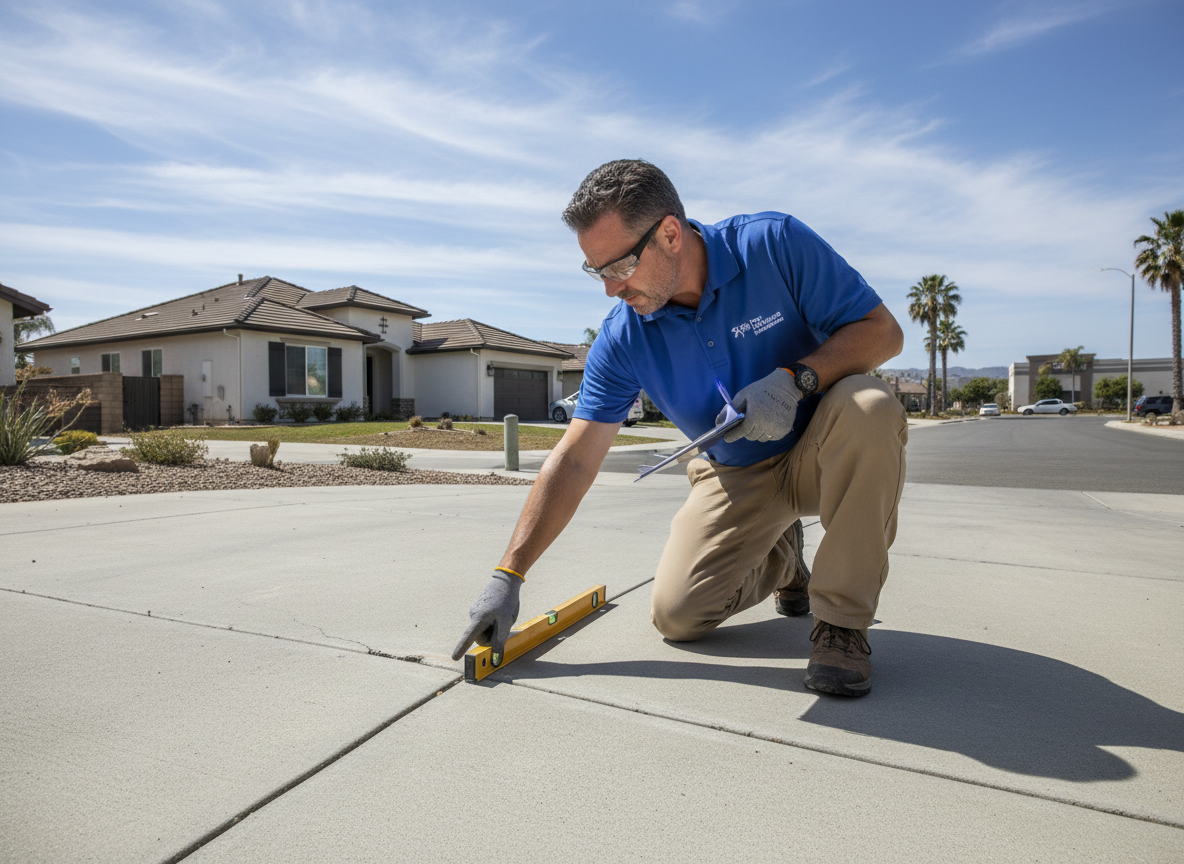
Inspect a Kearny Mesa driveway by checking every slab joint for height differences, measuring cracks, and watching where water travels after rain or irrigation. A vertical offset of 1/4 inch or more, a crack that continues widening, or a slab that directs water toward the garage deserves closer evaluation. Settlement is movement of the slab, not simply a mark on its surface, so the most useful inspection records elevation changes, drainage patterns, and whether the movement is getting worse.
Start With a Slow Walk From the Street
Begin at the driveway apron and walk toward the garage, looking across the surface rather than only down at it. Low-angle morning or late-afternoon light often makes tilted panels and raised joint edges easier to see. Kearny Mesa includes commercial properties, multifamily access points, and driveways exposed to repeated vehicle loading, so inspect the wheel paths as well as slab corners and joints.
Use a straight board or 6-foot level across suspicious areas. Do not rely on the bubble alone; measure the gap beneath the board and compare both sides of each joint. Mark findings with removable chalk and photograph the measuring tape in place.
Pay particular attention to:
- The transition between the street apron and driveway
- Control joints where neighboring slabs no longer align
- Garage-door thresholds and slab edges
- Corners beside planters, downspouts, or irrigation
- Depressions that hold water or collect sediment
These observations help determine whether driveway leveling is relevant or whether the issue is limited to surface wear.
Distinguish Settlement From Ordinary Cracking
Concrete can crack without settling, and filling a crack does not lift a sunken panel. A narrow crack with no measurable height difference may reflect shrinkage or minor movement. By contrast, differential settlement creates a change in elevation: one side drops, rotates, or separates from the adjoining slab. That displacement is what creates tire impacts, scraping, drainage trouble, and trip hazards.
Measure crack width at several points and record the date. A crack wider at one end, paired with a tilted slab or open space beneath an edge, is more significant than a uniform hairline crack. Also check whether the crack crosses a control joint or continues through multiple panels; that pattern can affect whether lifting is practical.
Avoid assuming that every uneven section needs complete replacement. If a slab remains structurally intact, sunken concrete repair may restore its position. Concrete with extensive breakup, severe spalling, or many independently moving fragments may not lift as a single stable panel and should be evaluated differently.
Check Water Sources and Drainage Paths
San Diego’s mild coastal Mediterranean climate means driveways avoid prolonged freeze-thaw exposure, but water still matters. Rainfall is seasonal, while landscape irrigation, leaking lines, and roof runoff can repeatedly wet a concentrated area. Water entering beside a slab can move loose material, soften poorly supported zones, or reveal an existing void when runoff carries fine sediment away.
Inspect shortly after rain or run normal irrigation long enough to see its actual path. Look for ponding that remains after surrounding concrete dries, soil washed from slab edges, damp joints, and water flowing toward the garage. Do not intentionally flood the driveway; the goal is observation, not a drainage test that could worsen the problem.
Conditions vary across San Diego County. Sloped sites near La Jolla and La Jolla Cove present different runoff behavior from flatter commercial parcels in Kearny Mesa, Mission Valley, or Downtown San Diego. The same principle applies in Chula Vista, Coronado, and La Mesa: identify where water begins, where it crosses concrete, and where it exits before deciding how to address settlement.
Measure the Safety and Functional Effects
A settled driveway becomes a priority when it interferes with normal use. Lay a ruler vertically against displaced joints and record the largest offset. An edge approaching 1/4 inch can catch a shoe, small wheel, hand truck, or bicycle tire, although actual risk also depends on location, lighting, and traffic. A similar inspection method is explained in checking sidewalks for trip hazards near Balboa Park.
Next, test function without forcing anything. Open and close the garage door, watch vehicle clearance at the apron, and confirm that gates can swing without contacting the slab. Look for fresh scrape marks on concrete and polished spots where tires repeatedly strike a raised edge. Near San Diego Zoo traffic corridors, North Park homes, Pacific Beach rentals, and busy Kearny Mesa properties, frequent pedestrian or vehicle use can make a modest offset more disruptive.
Document the full panel, not just the worst point. Concrete leveling must account for neighboring joints, garage elevations, and drainage outlets so correcting one edge does not create a new problem elsewhere.
Decide Whether Monitoring or Leveling Comes Next
After the inspection, create a simple record with dated photos, crack widths, joint offsets, and ponding locations. Recheck the same marked points after significant rain, irrigation repairs, or a few months of ordinary use. Stable cosmetic cracks may only need monitoring, while increasing offsets, recurring water collection, or visible voids justify a professional assessment.
Concrete leveling lifts an intact slab by placing material beneath it through drilled access holes. Mudjacking is a traditional form of this process that uses a pumpable cementitious mixture; suitability depends on slab condition, access, required lift, and what lies beneath the concrete. An on-site inspection is necessary before choosing a method because photographs cannot confirm support conditions below the slab.
Before arranging work, correct obvious water sources such as misdirected downspouts or overspray where practical. Owners comparing similar movement elsewhere can also review how drought cycles affect concrete in North Park. San Diego Concrete Leveling is available Mon–Fri, 8am–6pm, and Sat, 9am–2pm for driveway evaluations in San Diego.